Reading a phase transition from a hundred force traces
Sharath Koppu · Published 20 October 2026
A titanium–nickel single crystal pulled at a constant rate does not stretch smoothly. Somewhere along the way it gives — a martensitic transition — and the force drops.
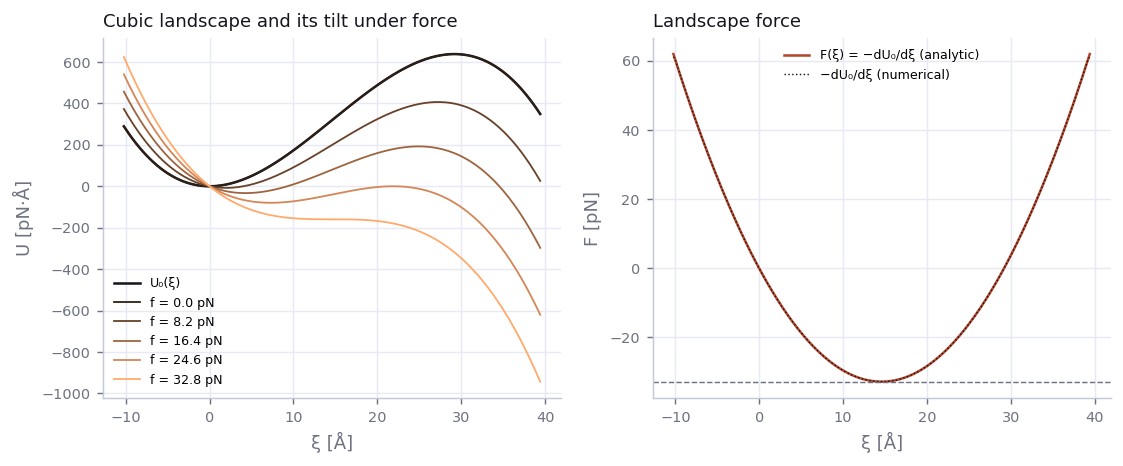
Maitra and Gururajan (Scientific Reports, 2025) described the statistics of that event with a cubic free-energy landscape that tilts under force. This project rebuilds their workflow from one hundred molecular-dynamics force–time traces, then takes it further in four versions.
Four versions
- The basic physics model: load, validate and average the hundred traces, and set them beside the landscape and its tilt under force.
- The inverse problem: infer the barrier U‡, the transition distance ξ‡ and the attempt rate Γ₀ by maximum likelihood from the critical-force sample, with profile likelihoods, a bootstrap, synthetic recovery and a comparison with the paper’s Table 1.
- The forward model: integrate the Smoluchowski–Fokker–Planck equation on the landscape under the force ramp — finite volume, Scharfetter–Gummel fluxes, backward Euler — with conservation and positivity by construction, an exact first-passage benchmark, and grid and time convergence.
- Inflect: curve analysis for any table of numbers — find the transitions before fitting the regimes, describe each stretch in words, and report every number with a bootstrap interval and a sixteen-setting stability sweep.
A detail worth keeping
The value reported at a transition is the one at its onset, not the largest reached — the extremum is a property of the noise. Across the 296-run sample set, Inflect singles out exactly the three files that came from a different population, and 201 automated tests hold the physics identities, solver benchmarks and inference recovery in place.
A new study and model building on this work is in progress. The code is on GitHub.
Sharath Koppu
AI & Software Engineer
One planner, two specialists
Ideas worth returning to.
Occasional writing. No noise.