When a small difference is not evidence
Sharath Koppu · Published 20 October 2026
Two economic series can each wander without bound while a combination of them stays put. That long-run equilibrium — cointegration — matters for exchange rates, the term structure of interest rates and pairs trading, and it demands careful calibration.
One tempting summary is directional. Take overlapping delay windows of a series and divide each window by its length: the result is a set of directions, summarised by a spatial-sign matrix, and two series can be compared through the entropy gap between their matrices. For most late observations the entries of a window are nearly equal, so the matrix drifts toward a fixed rank-one limit — and a small difference between two series starts to look like evidence that they move together.
What the limit actually is
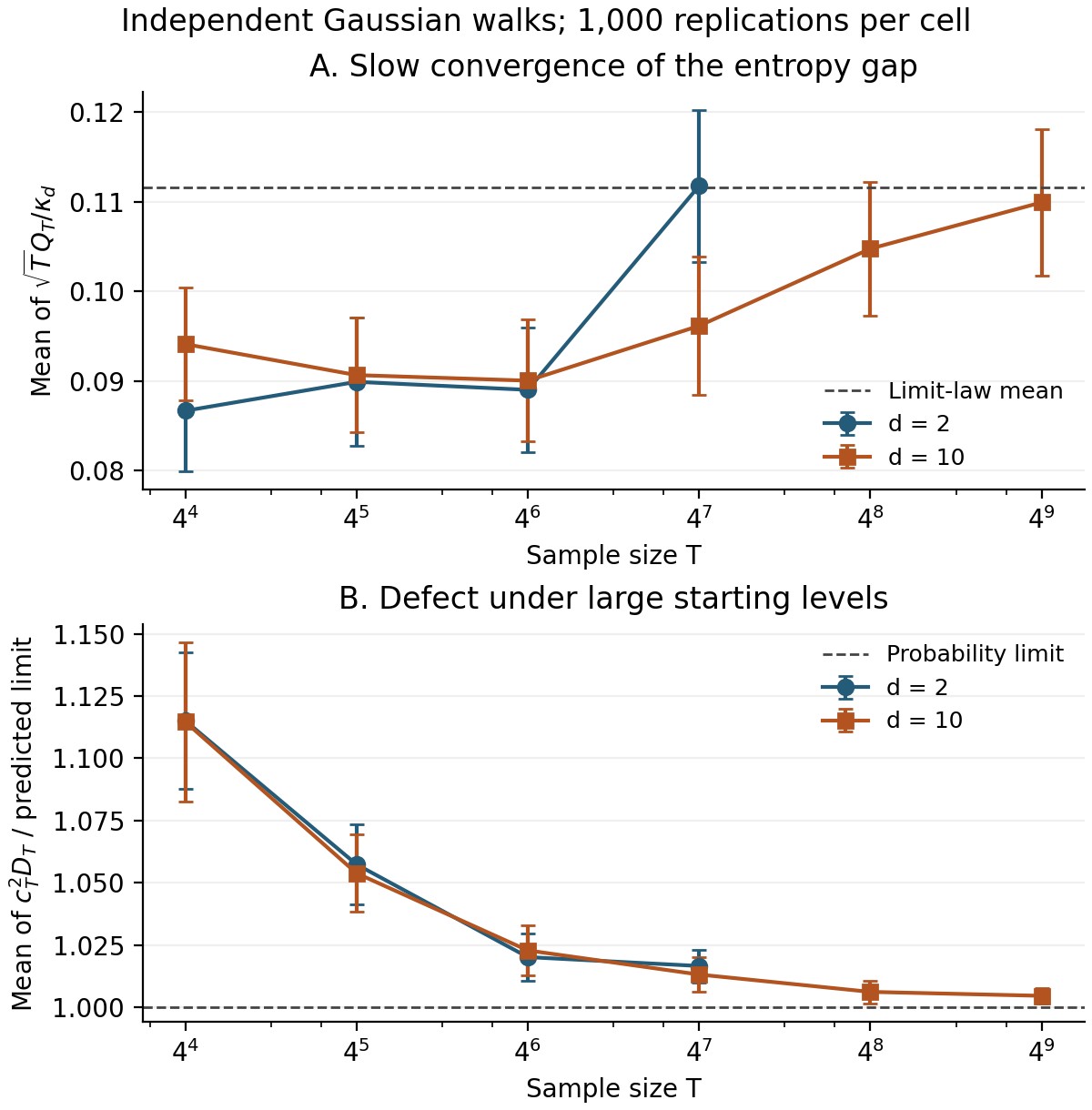
For integrated Gaussian random walks with a fixed window length, the fluctuations are governed by Brownian local time — a record of how often the limiting process revisits the origin. Proving it means accounting for the dependence created by overlapping windows and for the cancellation of signed tails. When the initial level is much larger than the random-walk fluctuations, a separate regime appears: the statistic shrinks at a different rate and its entropy gap collapses.
The calibration consequence
The limiting entropy law depends on the correlation between the innovations. So a lower-tail rule with a fixed positive cutoff at the square-root sample-size scale cannot be applied uniformly: for some non-cointegrated Gaussian pairs it rejects with probability approaching one. A small difference, on its own, is not evidence.
What the paper does not claim
It characterizes this statistic and its calibration limits; it does not establish a general bootstrap cointegration test. The work is with Prof. Luckshay Batra at BML Munjal University and is under review at Econometric Theory. The manuscript is on the research page.
Sharath Koppu
AI & Software Engineer
Reading a phase transition from a hundred force traces
Ideas worth returning to.
Occasional writing. No noise.